
The Best Way to Score Sourdough Without a Bread Lame
Last Updated: November 22, 2026
Quick Summary
You can score sourdough without a bread lame using a single-edge razor blade, a serrated bread knife, or kitchen scissors. The razor blade gives the most control for a pronounced ear, while the serrated knife is the safest and most beginner-friendly option. Whichever tool you pick, chill the dough first and cut about a quarter inch deep at a 30 to 45 degree angle in one confident stroke.
- A bare razor blade offers the highest control but the lowest safety of the three tools.
- Hold the knife at a 30 to 45 degree angle and cut about a quarter inch deep.
- Chill shaped dough for at least an hour so the surface stays firm before scoring.
- Keep decorative cuts shallow at about an eighth of an inch so they don't steal expansion.
- If a cut seals, bake anyway rather than rescoring over the failed slash.
Table of Contents
- Why You Don't Need a Bread Lame to Score Sourdough
- Household Tools That Score Sourdough Cleanly
- How to Score Sourdough With a Knife for Beginners
- How to Score Bread Without a Scoring Tool: Depth, Angle, and Grip
- Sourdough Scoring Tools Worth Keeping on the Counter
- Easy Sourdough Scoring Patterns for a Round Loaf
- When the Cut Drags, Tears, or Seals Shut
- Pick Your Scoring Tool and Bake Your First Loaf
- Frequently Asked Questions
Why You Don't Need a Bread Lame to Score Sourdough
You can score sourdough without a bread lame using a razor blade, a serrated bread knife, or kitchen scissors, and the loaf will still open with a good ear.
Scoring is the shallow cut made across the surface of shaped dough just before baking.
Here's what most guides get wrong: they treat scoring as a decorative skill. It's a structural one.
Below, we walk through which household tools work, how to hold them, and how to fix a cut that drags or seals shut.
Household Tools That Score Sourdough Cleanly
Three everyday tools score dough well enough to bake on: a single-edge razor blade, a serrated bread knife, and kitchen scissors. Each has a different job. None of them costs much, and two of them are probably in your kitchen right now. What most guides skip is the comparison: which tool gives you the most control, which is safest, which you already own, and which one suits the cut you're trying to make.
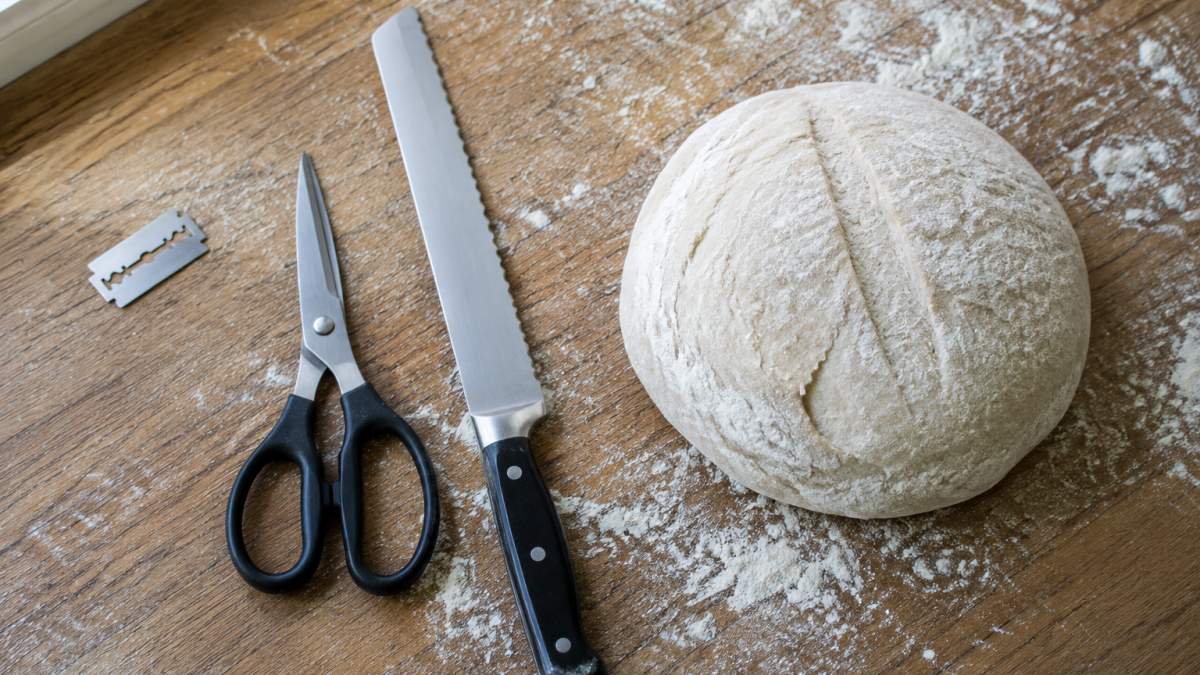
Razor Blade or Utility Blade
A bare razor blade is the closest thing to a lame you already own. It's thin, it's sharp, and it slices through a dough skin without dragging.
- Control: Highest of the three. The thin edge lets you steer a single expansion score or a fine decorative line without pushing dough down.
- Safety: Lowest. There's no handle and no guard, and wet dough makes fingers slip.
- Availability: High. Single-edge blades are sold at hardware and grocery stores, and many utility knives already hold one.
Watch out: a bare blade has no handle, and wet dough makes fingers slip. Dry your hands, keep the blade away from your palm, and set it down on the counter rather than in a sink.
Serrated Bread Knife
A serrated knife is the safest substitute and the one most beginners reach for first. The teeth grab the surface and start the cut, so you don't need a perfect angle to break through the skin.
- Control: Moderate. The teeth start the cut for you, but the wide blade is harder to steer in a tight curve.
- Safety: Highest. The handle keeps your hand well away from the edge, and the teeth are less likely to slip sideways.
- Availability: Highest. Almost every kitchen has one.
The trade-off is width. A bread knife makes a wider channel than a razor, so the cut opens less dramatically and the ear is smaller. It's still a clean, serviceable score.
Kitchen Scissors
Scissors snip rather than slice, which makes them useful for decorative work and small loaves. Hold the blades at a shallow angle and cut in short, quick snips along your line. The result is a slightly ragged edge, so keep scissors for patterns rather than the main expansion score.
- Control: Low for long cuts, high for short snips. You can stop and restart without dragging.
- Safety: Moderate. The handles protect your hand, but the tips can jab soft dough if you close them too far.
- Availability: Highest. Most kitchens have a pair.
Side-by-Side Comparison
| Tool | Control | Safety | Availability | Best Scoring Job |
|---|---|---|---|---|
| Razor or utility blade | Highest | Lowest | High | Single expansion score, big ear, fine decoration |
| Serrated bread knife | Moderate | Highest | Highest | Simple expansion score, beginner-friendly |
| Kitchen scissors | Low for long cuts, high for snips | Moderate | Highest | Small rolls, buns, short decorative snips |
Best for: bakers who want zero learning curve and don't mind a smaller ear. Skip if: you're chasing a pronounced ear on a high-hydration loaf.
A common pattern is that bakers who start with a serrated knife move to a razor blade once they want a bigger ear, then add scissors for decoration. You don't need all three on day one.
How to Score Sourdough With a Knife for Beginners
Learning how to score sourdough with a knife for beginners comes down to five steps. Work quickly, because the dough is cold and firm straight from the fridge and softens as it warms.
- Chill the shaped dough for at least an hour so the surface is firm.
- Dust the top lightly with flour and brush off the excess.
- Hold the knife at a 30 to 45 degree angle to the surface, not straight down.
- Cut about a quarter inch deep in one steady motion, not a sawing motion.
- Bake immediately, before the cut has time to close.
The most common mistake is hesitating halfway through. A slow cut drags the dough and leaves a gummy channel. Commit to the stroke. If you're new to shaping as well as scoring, our guide to essential sourdough tools for small batches covers the rest of the basic setup.
How to Score Bread Without a Scoring Tool: Depth, Angle, and Grip
Depth, angle, and grip decide whether a cut opens or seals.
Depth: aim for about a quarter inch, roughly the depth of a pencil line. Shallow scores barely open.
Grip: grip the tool close to the cutting edge for control. Your wrist does the work, not your shoulder.
What most guides miss is that tool control matters more than sharpness past a certain point.
| Goal | Depth | Angle | Best Household Tool |
|---|---|---|---|
| Big ear on a boule | 1/4 inch | 30 degrees | Razor blade |
| Simple expansion score | 1/4 inch | 45 degrees | Serrated bread knife |
| Decorative leaf or wheat | 1/8 inch | 45 degrees | Scissors or razor tip |
| Small rolls and buns | 1/8 inch | 45 degrees | Scissors |
Angle
Sourdough Scoring Tools Worth Keeping on the Counter
If you score often, a dedicated tool earns its space.
What we'd keep within reach: a lame with a replaceable blade, a bench scraper for cleanup, and a light flour dredger. That's it. Everything else is optional.
A common mistake is buying a decorative scoring kit before learning the single expansion score. Learn one clean cut first. Patterns come later, and they're easier once your hand knows the angle.
Easy Sourdough Scoring Patterns for a Round Loaf
Simple sourdough scoring patterns start with one cut, then add shallow decoration around it. For a round loaf, the classic is a single slash across the top, about a third of the way in from one edge.
Once that's consistent, try these:
- Cross: two slashes at right angles, each a quarter inch deep.
- Leaf: one long center cut with short angled cuts down each side.
- Wheat stalk: a center line with paired diagonal cuts, made shallow.
Keep decorative cuts shallow, about an eighth of an inch. They're for looks, and deep decoration can steal expansion from your main score.
When the Cut Drags, Tears, or Seals Shut
A dragging cut usually means a dull blade, a warm dough surface, or too much flour on top. Fix the blade first, then the dough. But the fix changes depending on what the dough is doing. Here's how to read the symptom and match it to the condition.
Sticky Dough
If the blade gums up and the cut smears instead of slicing, the surface is too wet. Lightly dust the top with flour and brush off the excess with your hand or a pastry brush. Too much flour clogs the blade, so aim for a thin, even film rather than a heavy coat. A common pattern is that high-hydration doughs need a firmer chill and a lighter dust than stiff doughs.
Warm Dough
Dough that has been sitting out softens fast, and a warm surface seals a cut within seconds. Work straight from the fridge, and if the dough has warmed, return it to the refrigerator for 10 to 15 minutes before scoring. Bake immediately after the cut so the slash doesn't have time to close.
Overproofed Dough
Overproofed dough is slack and full of gas, so a cut tends to deflate the loaf instead of opening it. Score shallower than usual, about an eighth of an inch, and use a single decisive stroke rather than a long slash. Handle the dough gently when you move it to the oven, because the structure is already weak.
Underproofed or Cold Dough
Dough that is underproofed or very cold resists the blade and tears rather than slices. Let it sit at room temperature for a few minutes to take the chill off the surface, then score with one firm stroke. Don't saw back and forth, which tears the skin and leaves a ragged channel.
Dough That Resists the Knife
If a serrated knife skips across the surface instead of biting in, the teeth are too dull or the angle is too steep. Switch to the tip and the first few serrations, lower the angle toward 30 degrees, and start the cut with a gentle forward push rather than a downward press. A razor blade will cut through dough a serrated knife can't, which is why many bakers keep one on hand for stubborn loaves.
Quick Symptom-to-Fix Table
| Symptom | Likely Cause | Fix |
|---|---|---|
| Blade gums up, cut smears | Sticky, wet surface | Light dusting, brush off excess |
| Cut seals within seconds | Warm dough | Chill 10-15 minutes, bake immediately |
| Loaf deflates when cut | Overproofed dough | Score shallower, one gentle stroke |
| Dough tears instead of slicing | Underproofed or very cold | Warm a few minutes, one firm stroke |
| Knife skips across surface | Dull teeth or steep angle | Use the tip, lower to 30 degrees |
Watch out: rescoring over a failed cut rarely helps. It tears the surface and leaves a scar. If a cut seals, bake anyway. The loaf will still taste good, and you'll know what to change next time.
Pick Your Scoring Tool and Bake Your First Loaf
The best way to score sourdough without a bread lame is to start with what you own, learn the angle, and upgrade only when the tool is the thing holding you back. A razor blade and a steady hand will outperform an expensive lame used timidly.
When you're ready for a tool with a guard and a replaceable blade, our white magnetic retractable bread lame comes with five blades and a scoring guide, and the professional baking set bundles a lame with a dough whisk and scraper. For first-time bakers who want everything in one box, The First Loaf Box includes starter and baking essentials.
Scoring is the last step where a beginner loaf goes wrong, and it's the easiest one to fix.
Frequently Asked Questions
Can I score sourdough with a regular kitchen knife?
A regular chef's knife will cut dough, but the thick spine and blunt tip tend to drag and compress the surface instead of slicing it. A serrated bread knife works better because the teeth catch and start the cut. Whichever you use, make sure it is genuinely sharp and hold it at a shallow angle so the blade slices rather than presses. A dull knife is the most common reason a score tears instead of opening cleanly.
How deep should I score sourdough bread?
For a single expansion score on a round loaf, aim for about 1/2 inch to 3/4 inch deep, cutting at a 30 to 45 degree angle to the surface. Shallow decorative cuts only need 1/4 inch or less. The expansion score is the one that controls oven spring, so it should be the deepest. If you cut too shallow, the loaf splits wherever it wants instead of opening along your line.
Why does my knife drag when I score sourdough?
Dragging usually comes from one of three things: a dull blade, dough that is too warm and sticky, or a slow, hesitant motion. Chill the shaped dough in the refrigerator for 30 to 60 minutes before scoring so the surface firms up, dust it lightly with flour, and cut in one confident stroke rather than sawing back and forth. A sharp blade and cold dough do more for a clean cut than any single tool.
Should I score sourdough before or after chilling it?
Score after the final proof, right before the loaf goes into the oven, and chilling first makes that easier. A cold, firm surface holds its shape when the blade passes through, so the cut stays open instead of sealing shut. Pull the dough straight from the refrigerator, score it in under a minute, and load it immediately. Waiting too long at room temperature softens the skin and undoes the benefit.
Do I need a sourdough lame to get a good ear?
No. A single-edge razor blade held between your fingers produces the same thin, angled cut a lame does. What a dedicated lame adds is control and safety: a handle keeps your fingers away from the blade, and a retractable design covers it in storage. If you score often, a tool like the retractable magnetic lame from My Rustic Roots at $12.95 is worth the small cost for the grip alone.
