
7 Reasons Your Sourdough Starter Smells Like Vinegar
Last Updated: October 30, 2026
Quick Summary
A sourdough starter that smells like vinegar is hungry, because the yeast have run out of food and acetic acid has built up. Discard most of it, feed with fresh flour and water every 12 to 24 hours, and most starters recover within three to five feedings.
- Acetic acid builds up when the starter ferments with limited oxygen, such as under a tight lid.
- Discard all but about 2 tablespoons of starter, then feed equal parts flour and water by weight.
- Keep the starter at room temperature around 70 to 75°F and cover it loosely so oxygen gets in.
- A recovered starter doubles within 4 to 8 hours of a 1:5:5 feed and smells mildly tangy.
- Vinegar is a feeding problem, not spoilage; rotten or musty smells with fuzz mean you should start over.
Table of Contents
- Why Your Sourdough Starter Smells Like Vinegar
- How to Fix a Sourdough Starter That Smells Like Vinegar
- How Often to Feed Sourdough Starter to Stop the Sharp Smell
- When Your Sourdough Starter Smells Like Acetone
- What Does Spoiled Sourdough Starter Smell Like?
- Temperature, Hydration, and Flour: The Conditions Behind the Smell
- How to Tell Your Starter Has Recovered and Is Ready to Bake
- Rebuild a Reliable Feeding Routine with the Right Starter Kit
- Frequently Asked Questions
Why Your Sourdough Starter Smells Like Vinegar
A sourdough starter that smells like vinegar is hungry: the yeast are running out of food, and fermentation has tipped from balanced and bready toward acidic.
At My Rustic Roots, this is one of the most common questions from new bakers, and it's easy to correct.
The smell comes from acetic acid, which builds up when your starter ferments without enough oxygen or fresh flour; as yeast run low on food, acid-loving bacteria take over the flavor.
The short answer: feed it, and feed it more often.
Acetic Acid, Oxygen, and the Fermentation Shift
Fermentation runs on wild yeast and lactic acid bacteria. When the starter is well fed, yeast produce carbon dioxide and a mild, tangy smell; when food runs out, the balance tips.
Acetic acid forms when the starter ferments with limited oxygen.
So the fix is rarely complicated: you're not fighting a contaminant, just correcting the conditions that let acetic acid take over.
How to Fix a Sourdough Starter That Smells Like Vinegar
To fix a sourdough starter that smells like vinegar, discard most of it, feed it with fresh flour and water, and repeat every 12 to 24 hours until the smell turns mild and bready.
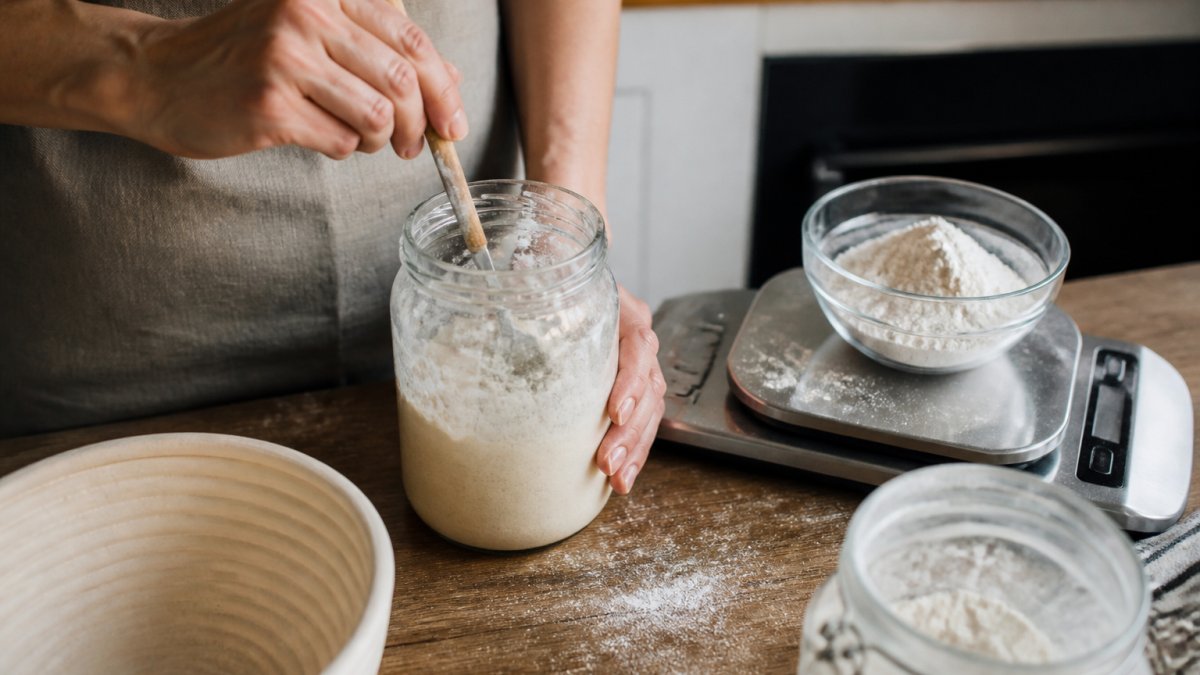
A common mistake is feeding a starving starter a huge meal and then waiting days. That gives acetic acid more time to build. Smaller, more frequent feedings work better.
A Step-by-Step Recovery Plan
Follow this plan exactly, and keep notes on smell and rise.
- Pour off any dark liquid. That liquid on top is hooch, a sign the starter is hungry. Stir it in or pour it off, then proceed.
- Discard all but about 2 tablespoons of starter. Keeping less makes the next feeding more effective.
- Feed with equal parts flour and water by weight. Start with 50 grams starter, 50 grams flour, 50 grams water.
- Stir well and cover loosely. A breathable cover lets oxygen in, which helps yeast over acetic bacteria.
- Keep it at room temperature, around 70 to 75°F. Cool rooms slow fermentation and let acid build.
- Repeat every 12 hours for three to five days. Smell the starter before each feeding.
- Watch for bubbles and rise. A healthy starter doubles within four to eight hours of feeding.
Expected result: By day three to five, the sharp smell fades to a mild tang, and the starter rises reliably. If the vinegar smell is still strong after a week of consistent feeding, the starter may need a fresh start.
Recovery Checkpoints for the Next Three Feedings
Instead of vaguely "feeding more often," use these observable checkpoints.
Feeding 1 (rescue feed). Discard down to 25 g starter.
Feeding 2 (12 hours later). Discard down to 25 g. Feed 25 g starter + 125 g flour + 125 g water.
Feeding 3 (12 hours later). Discard down to 25 g. Feed 25 g starter + 125 g flour + 125 g water.
Adjust the Fix to Your Starter's Age and Storage
The same vinegar smell calls for different corrections depending on what kind of starter you keep.
- New starter (under 2 weeks old). A vinegary smell here is common and usually means the culture is still establishing. Keep a 1:1:1 ratio (25 g starter + 25 g flour + 25 g water) and feed every 12 hours at 75-80°F. Do not jump to large ratios yet, a young starter cannot handle a big meal and may stall. Expect the smell to settle once it reliably doubles within 6-8 hours.
- Mature room-temperature starter. This is the classic underfed case. Move from 1:1:1 to 1:5:5 and feed every 12 hours. If the smell returns within 8 hours of a 1:5:5 feed, your kitchen is warm enough that the starter needs a larger ratio (1:10:10) or twice-daily feeds.
- Refrigerated starter. A cold starter often smells sharply of vinegar when you bring it out because fermentation has continued slowly for a week or more. Do not bake with it straight from the fridge. Feed it 1:5:5 at room temperature and let it sit 12 hours, then feed again at 1:5:5 before judging the smell. Two warm-up feeds usually reset a refrigerated starter.
What Counts as Recovered
Smell alone is a poor test because acetic acid lingers after the yeast recover. Use three measurable signs together: the starter doubles within 4-8 hours of a 1:5:5 feed, the top is domed rather than flat or collapsed, and the smell at peak is mildly tangy rather than sharp. If all three hold for two consecutive feedings, the starter has recovered and is ready to bake.
How Often to Feed Sourdough Starter to Stop the Sharp Smell
Feed a sourdough starter every 12 hours at room temperature to prevent a sharp smell, because yeast burn through flour fast in a warm kitchen.
How often to feed sourdough starter depends on temperature, how much starter you keep, and how active it is. Warmer kitchens mean faster cycles; if your starter smells vinegary within a day of feeding, it needs a bigger meal or a more frequent schedule.
Feeding Ratios: 1:1 Versus 1:5:5
The feeding ratio is the amount of starter compared to flour and water. A 1:1:1 ratio means equal parts of each. A 1:5:5 ratio means one part starter to five parts flour and five parts water.
| Feeding Ratio | Starter : Flour : Water | Best For | How Long It Lasts |
|---|---|---|---|
| 1:1:1 | 1 : 1 : 1 | New starters, warm kitchens | 4-6 hours at room temp |
| 1:2:2 | 1 : 2 : 2 | Daily maintenance | 6-8 hours |
| 1:5:5 | 1 : 5 : 5 | Hungry starters, overnight feeds | 8-12 hours |
| 1:10:10 | 1 : 10 : 10 | Fridge storage, long gaps | 12+ hours |
A 1:1 ratio feeds often and keeps the starter mild. A 1:5:5 ratio gives the starter a bigger meal, which is exactly what a vinegary starter needs.
When Your Sourdough Starter Smells Like Acetone
A sourdough starter that smells like acetone, nail polish remover, or paint thinner is over-fermented. That smell means the starter has burned through its food and is producing compounds called alcohols and ketones.
Sourdough Starter Jar Kit – 25 oz with free bag of starter included →
Acetone odors show up when a starter sits too long after feeding or ferments warm for hours without a refresh.
Watch out: an acetone smell paired with a layer of liquid and no bubbles after feeding means the yeast are badly stressed.
What Does Spoiled Sourdough Starter Smell Like?
Spoiled sourdough starter smells rotten, musty, or like mold, not sour. A healthy starter smells tangy and yeasty, like yogurt or fresh bread; a spoiled one smells like garbage, damp basement, or old cheese, often with visible fuzz or dark patches.
Vinegar is not spoilage, the most common point of confusion, and one that costs bakers good starters every week. A sharp, acidic odor is a feeding problem; a rotten odor is a safety problem.
Vinegar, Alcohol, Acetone, and Mold: Telling Them Apart
Use this guide to identify what your nose is telling you.
- Vinegar: sharp and acidic, like salad dressing. Cause: hunger and low oxygen. Fix: feed more often.
- Alcohol: beery or yeasty, like a brewery. Cause: over-fermentation. Fix: refresh and shorten feed times.
- Acetone: chemical, like nail polish remover. Cause: severe over-fermentation. Fix: feed twice daily with a high ratio.
If you see pink, orange, or black streaks, or any fuzzy growth, throw the starter out. Do not try to salvage it. A fresh, mature starter removes the guesswork, and our organic non-GMO mature sourdough starter gives you a reliable culture to begin again.
Temperature, Hydration, and Flour: The Conditions Behind the Smell
Temperature, hydration, and flour type all shape how fast your starter ferments and how sharp it smells.
A thicker, stiffer starter ferments more slowly and tends to develop more acetic acid, while a wetter starter ferments faster and stays milder.
Flour choice plays a role as well. Whole grain and rye flours feed yeast well because they carry more nutrients.
How Each Variable Pushes Fermentation Toward Acetic Acid
A vinegar smell is not random, it is the predictable result of conditions that favor acetic acid bacteria over yeast.
Temperature. Wild yeast are most active around 75-82°F, while acetic acid bacteria tolerate cooler and warmer extremes and keep producing acid when yeast slow down.
Hydration. Acetic acid bacteria are more active in stiff starters and yeast in wet ones.
Feeding ratio. The ratio ties the other variables together.
A Simple Prevention Schedule
Use this as a starting point and adjust based on the checkpoints in the recovery section above.
| Condition | Target Hydration | Feeding Ratio | Feeding Interval |
|---|---|---|---|
| Warm kitchen (75-80°F), white flour | 100% | 1:5:5 | Every 12 hours |
| Warm kitchen, whole wheat or rye | 100% | 1:10:10 | Every 12 hours |
| Cool kitchen (65-70°F), white flour | 100% | 1:2:2 | Every 12-24 hours |
| Refrigerator storage | 100% | 1:10:10 | Every 5-7 days |
If the vinegar smell returns before the next scheduled feed, move one row toward a larger ratio or a shorter interval. If the starter peaks and collapses well before the next feed, the ratio is too small for your conditions. These two adjustments cover most recurrence cases without changing flour or hydration.
How to Tell Your Starter Has Recovered and Is Ready to Bake
Test readiness with the float test: drop a spoonful of starter into a glass of water. If it floats, it holds enough gas to raise bread. If it sinks, give it another feeding cycle.
Once your starter passes both checks, you are ready for your first loaf. Our First Loaf Box bundles a starter culture, dough whisk, scraper, bread lame, and a printed recipe so a beginner has everything needed for that first bake.
Rebuild a Reliable Feeding Routine with the Right Starter Kit
A consistent routine keeps the vinegar smell from coming back. Most starter problems trace to irregular feeding, and the right tools make a regular schedule easier to keep.
Our Sourdough Starter Jar Kit is a 25 oz glass jar with easy-to-read feeding and temperature markings, a wide mouth for simple cleaning, and a bonus starter packet included. The markings let you see exactly how much your starter has risen, which is the clearest signal of health you have.
Here is how we would set up a routine that sticks:
- Feed at the same times each day, morning and evening.
- Use a 1:5:5 ratio if you feed once a day, or 1:1:1 if you feed twice.
- Keep the jar loosely covered so oxygen can reach the starter.
Frequently Asked Questions
Is my sourdough starter okay if it smells like vinegar?
In most cases, yes. A vinegary odor points to acetic acid, which builds up when a sourdough starter has gone too long without food or has fermented past its peak. The starter is usually still alive and can be brought back with regular feedings. Check for fuzzy mold, pink or orange streaks, or a rotten smell; those are signs to discard it. A sharp but clean vinegar smell is a feeding problem, not a spoilage problem.
Should I throw away a sourdough starter that smells sour?
Not automatically. A sour smell from acetic acid is normal in small amounts and is part of what gives sourdough its flavor. Throw it out only if you see mold on the surface or in the jar, pink or orange discoloration, or a smell like rotten food or sewage. If none of those appear, pour off any dark liquid (hooch), discard all but a spoonful, and feed with fresh flour and water at room temperature.
How do I fix a sourdough starter that smells like vinegar?
Feed it more often and in larger ratios. Discard all but about a tablespoon of starter, then add flour and water at a 1:5:5 ratio by weight (for example, 10 g starter, 50 g flour, 50 g water). Keep it at room temperature, around 70 to 75 F, and repeat every 12 hours until the sharp smell fades and the starter doubles within 4 to 8 hours. A jar with clear markings makes it easier to track the rise.
How often should I feed a sourdough starter to reduce its vinegar smell?
Feed once or twice a day at room temperature while you are correcting a vinegar smell. A starter kept on the counter typically needs feeding every 12 to 24 hours; one stored in the refrigerator can go a week or more between feedings, but it will build a stronger acidic odor during that time. If the smell returns quickly, increase the feeding ratio to 1:5:5 or move to twice-daily feedings until the starter rises predictably.
A vinegary starter is a fixable starter, and the fix starts with a better feeding routine. If you want a reliable foundation from day one, My Rustic Roots offers organic, non-GMO freeze-dried starters and the tools to maintain them, all family owned and made in the USA. Get started with My Rustic Roots and turn that sharp smell into your first beautiful loaf.
