
Benefits of Using Organic Sourdough Starter for Better Bread
Table of Contents
- Why an Organic Sourdough Starter Changes Everything
- Health Benefits of Sourdough Bread Backed by Fermentation
- Organic vs Conventional Sourdough Starter: What Actually Differs
- Flavor, Digestion, and the Microbial Activity of Organic Starters
- How Often to Feed Sourdough Starter for Steady Results
- Sourdough Starter Feeding Ratio: Getting the Numbers Right
- Long-Term Maintenance, Microbial Stability, and Environmental Impact
- Conclusion: Start With a Starter You Can Trust
- Frequently Asked Questions
Last Updated: October 5, 2026
Why an Organic Sourdough Starter Changes Everything
The benefits of using organic sourdough starter start with what you cannot see. A starter is a living colony of wild yeast and bacteria, and the flour you feed it becomes that colony's environment.

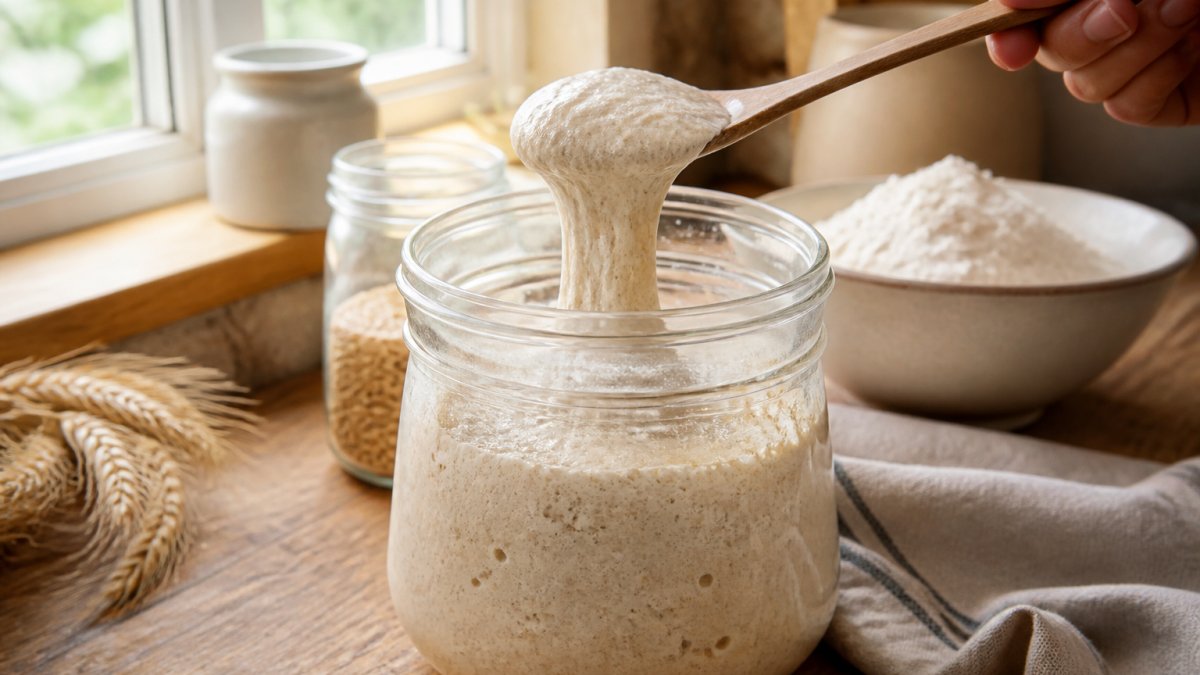
An organic sourdough starter is a leavening culture maintained exclusively on organically grown flour and water, relying on wild yeast and lactic acid bacteria rather than commercial yeast.
Most people treat "organic" as a marketing label on a bag of flour. In a starter, it is a variable in a biological system you are trying to keep stable for years.
Health Benefits of Sourdough Bread Backed by Fermentation
The health benefits of sourdough bread come from fermentation, not the bread itself. During a long ferment, wild yeast and lactobacillus break down compounds that ordinary yeasted bread carries intact, which is what separates sourdough from a fast commercial loaf.
How Wild Yeast and Lactobacillus Break Down Phytic Acid
Phytic acid is a naturally occurring compound in whole grains that binds minerals like iron, zinc, and magnesium, making them harder to absorb. During sourdough fermentation, lactobacillus produces enzymes that degrade phytic acid over time, and a longer, slower ferment gives them more hours to work. That is why an extended bulk rise is about bioavailability, not just flavor: how much of a grain's mineral content your body can actually use. Feed your starter organic whole grain flour and you keep the mineral content high while fermentation unlocks it.
Blood Sugar Response and the Glycemic Index of Sourdough
Sourdough fermentation changes how your body processes the starch in bread. The acids produced slow starch breakdown, generally producing a gentler blood glucose response than fast-risen commercial bread, which is why the glycemic index of sourdough tends to run lower than conventional white bread. Anyone managing metabolic health should treat this as one factor among many, not a green light to eat unlimited bread.
Organic vs Conventional Sourdough Starter: What Actually Differs
What is in the flour. Organic flour is milled from grain grown without synthetic nitrogen fertilizers.
What is on the flour. Conventional wheat can carry residues of synthetic pesticides and fungicides applied in the field or in storage. Organic flour is prohibited from those inputs under USDA organic certification standards.
How consistently the culture responds. A starter's microbial community adapts to whatever it is fed.
| Factor | Organic Starter | Conventional Starter |
|---|---|---|
| Flour inputs | Organic, non-GMO grain | May include conventional flour, treated seed |
| Pesticide residue load | Prohibited under organic standards | Can vary by source and storage |
| Mineral and enzyme density | Generally higher in whole grain organic | Varies with farming system |
| Microbial stability | More consistent over long ferments | Can shift with flour changes |
| Flavor development | Fuller, more complex tang | Varies by flour source |
| Long-term maintenance | Predictable feeding response | Less predictable over time |
A practical note: switching from a conventional starter to an organic one takes roughly one to two weeks of regular feedings before the culture settles into its new baseline.
Flavor, Digestion, and the Microbial Activity of Organic Starters
Flavor complexity in sourdough comes from two acids in balance: lactic acid brings a mild, yogurt-like tang, acetic acid a sharper, vinegar-forward note. Their ratio shifts with hydration, temperature, and ferment length. An organic starter fed on organic whole grain flour develops a deeper flavor profile because whole grains carry more of the bran and germ that feed acid production.
Digestibility improves along the same timeline. The longer the ferment, the more the culture pre-digests starches and proteins, which is why many people who find commercial bread heavy report that a well-fermented sourdough sits more easily. For anyone with a genuine gluten sensitivity, though, sourdough is not a safe substitute for a gluten-free diet.
How Often to Feed Sourdough Starter for Steady Results
How often to feed sourdough starter depends on where you keep it and how active you need it. A room-temperature starter typically needs feeding once or twice a day; a refrigerated one can go a week or more between feedings, though it needs a day or two of regular feeding to wake back up before you bake.
Signs your starter is ready for a feeding:
- It has risen and started to fall back on itself
- A dark liquid layer has appeared on top
- It smells sharply of acetone or alcohol rather than pleasantly sour
- It no longer doubles within its usual window
A common mistake is feeding on a rigid clock instead of reading the starter. Warm kitchens speed fermentation; cold kitchens slow it. Feed the culture you have, not the one the schedule assumes.
Sourdough Starter Feeding Ratio: Getting the Numbers Right
The sourdough starter feeding ratio is the proportion of starter to flour to water you use at each feeding. The most common ratios are 1:1:1 for maintenance and 1:5:5 for building strength before a bake.
Purple Bag Organic Non-GMO Freeze-Dried Sourdough Starter – 12g San Francisco →
- 1:1:1 (equal parts starter, flour, water): fast fermentation, good for daily room-temperature maintenance
- 1:5:5: slower, gentler feeding that builds a stronger, less acidic culture before baking
- 1:10:10: used to tame an over-acidic starter or revive one that has gone too long between feedings
Weigh your ingredients rather than measuring by volume. A cup of flour varies in weight depending on how it is scooped, and inconsistent ratios are a common reason a starter behaves differently every time.
Long-Term Maintenance, Microbial Stability, and Environmental Impact
Long-term starter care is really microbial management. A culture that gets consistent flour, ratios, and temperatures develops a stable colony that behaves predictably; change all three at once and you will see sluggish rises and off flavors for days. The interesting part is what "stable" actually means inside the jar.
What Microbial Stability Looks Like Over Months and Years
A healthy sourdough starter is not one organism but a community of wild yeasts (most commonly Kazachstania and Saccharomyces strains) and lactic acid bacteria (typically Lactobacillus species) living in a flour-and-water matrix. The yeasts produce carbon dioxide that lifts the dough; the bacteria produce the lactic and acetic acids that give sourdough its tang and break down phytic acid and gluten proteins.
The community stabilizes through a simple mechanism: whatever you feed it, repeatedly, selects for the microbes that thrive on that food. Feed organic whole grain flour at a consistent ratio and temperature and within a few weeks the population shifts toward the strains best suited to that substrate.
What destabilizes it:
- Rotating flour brands or types. Each flour carries its own microbial load and its own starch and enzyme profile. Switching every few weeks keeps the colony in a constant state of re-adaptation.
- Big temperature swings. A starter kept at 68°F one week and 78°F the next will shift its acid balance, warmer favors lactic acid (milder), cooler favors acetic acid (sharper).
- Irregular feeding intervals. A culture fed every 12 hours for a week and then left for four days will bounce between peak activity and near-starvation.
- Chlorinated water. Municipal tap water treated with chlorine can suppress microbial activity. Most bakers find filtered or rested water gives more consistent results.
The Environmental Case for Organic Starter Flour
The flour you feed a starter is a recurring purchase, not a one-time one. A starter fed weekly at 1:5:5 uses roughly 100 to 150 grams of flour per feeding, call it 5 to 8 kilograms a year for maintenance alone, before the flour that goes into actual loaves. Over a decade, that is a meaningful volume of grain, and the farming system behind it matters.
Organic grain production is required under USDA organic certification standards to avoid synthetic nitrogen fertilizers and most synthetic pesticides. The practical environmental differences most commonly cited by agricultural researchers include:
- Lower synthetic nitrogen runoff. Synthetic nitrogen that is not taken up by crops can leach into groundwater and waterways, contributing to algal blooms and dead zones. Organic systems rely more on compost, manure, and legume cover crops, which release nitrogen more slowly.
- Higher soil organic matter over time. Organic rotations that include cover crops and perennial phases tend to build soil carbon rather than deplete it, which supports long-term soil health and water retention.
- Greater on-farm biodiversity. Avoiding broad-spectrum pesticides tends to leave more beneficial insect and soil microbial populations intact.
None of this makes a jar of starter a climate solution. But choosing organic flour for a culture you feed every week for years is a small, repeatable choice with a cumulative footprint, and it is the same choice that gives you the more stable microbial environment described above. The two benefits come from the same sourcing decision.
For bakers who want a dependable starting point, our USDA organic certification standards guidance on what "organic" actually requires is worth reading before you buy any starter or flour. Freeze-dried organic starters also solve the stability problem from the other direction: they sit dormant with a long shelf life until you are ready to activate them.
Conclusion: Start With a Starter You Can Trust
The hardest part of sourdough is not the recipe. It is keeping a living culture alive and predictable long enough to bake with confidence. Starting from an organic, non-GMO freeze-dried culture removes the most common failure point, and feeding it organic flour keeps the microbial community stable over the long haul.
My Rustic Roots makes small-batch, organic, non-GMO freeze-dried starters, including our Organic Mature Sourdough Starter for faster activation and a milder flavor. Every pouch is made in the USA by a family-owned operation, with a batch number and expiration date printed on it so you know exactly what you are getting. Get started with My Rustic Roots and bake bread you can actually be proud of.
Frequently Asked Questions
Does an organic sourdough starter make bread healthier?
An organic sourdough starter does not change the basic nutrition of flour, but it does influence fermentation. Because organic starters are made with organic, non-GMO flour, they avoid synthetic pesticide residues that can affect microbial activity. A healthy culture of wild yeast and lactobacillus breaks down phytic acid, which supports mineral absorption, and pre-digests some starches. The result is bread that is easier to digest and offers more bioavailable nutrients than bread made with a weak or inconsistent starter.
How often should you feed a sourdough starter to keep it active?
A starter kept at room temperature typically needs feeding every 12 to 24 hours. In warm kitchens, every 12 hours works well; in cooler conditions, once a day is often enough. If you store your starter in the refrigerator, feed it once a week and let it sit out for a few hours before baking. Watch for a domed top and a slightly sour smell. A starter that smells like acetone or shows dark liquid on top is hungry and needs a fresh feeding.
What is the 1:3:3 rule for sourdough starter?
The 1:3:3 rule means one part starter, three parts flour, and three parts water by weight. If you keep 20 grams of starter, you add 60 grams of flour and 60 grams of water. This ratio gives the yeast and bacteria enough fresh food to ferment without becoming overwhelmed. It is a reliable feeding ratio for maintaining a steady, predictable rise, and it works well whether you bake daily or a few times a week.
Is organic sourdough starter easier to digest?
The organic label itself does not make a starter easier to digest, but the fermentation process does. During a long ferment, wild yeast and lactobacillus produce lactic and acetic acid that break down gluten and complex carbohydrates. This pre-digestion is why many people with mild gluten sensitivity find sourdough easier on the stomach. An organic starter supports a diverse, stable microbial community, which keeps that fermentation consistent from loaf to loaf.