
Sourdough Bread Scoring Tools: A 2026 Guide
Table of Contents
- Why Sourdough Bread Scoring Tools Matter
- Types of Bread Scoring Tools: Retractable Lames vs. Wooden Handles
- How to Score Sourdough Bread for Beginners
- Deep vs. Shallow Scoring Sourdough: Technique and Purpose
- Sourdough Scoring Patterns: Creating Decorative and Functional Designs
- Maintaining Dough Tension and Avoiding Common Scoring Mistakes
- Replacing Razor Blades Safely and Maintaining Your Scoring Tool
- Frequently Asked Questions
Last Updated: September 27, 2026
Why Sourdough Bread Scoring Tools Matter
Scoring your sourdough isn't just for looks. A well-placed cut controls where your dough expands as it hits the oven's heat, directing oven spring upward instead of letting the loaf split randomly across the crust. Without scoring, you lose that signature ear and risk an unpredictable, dense crumb structure underneath.
The difference between a scored and unscored loaf is dramatic. Scoring creates a deliberate weak point where steam can escape in a controlled way. This gives you the artisan bread appearance and the open crumb structure that separates homemade sourdough from store-bought. For beginners, the right sourdough bread scoring tools make this process simple and repeatable.
We've worked with home bakers who struggled with scoring because they were using the wrong tool or technique. The most common issue? Using a dull blade or holding it at the wrong angle, which drags through the dough instead of slicing cleanly. A sharp, properly-angled blade makes the difference between a confident score and a frustrating mess.
This guide covers the tools that actually work, the techniques that matter, and the mistakes to avoid so your next loaf looks as good as it tastes.
Types of Bread Scoring Tools: Retractable Lames vs. Wooden Handles
Choosing between a retractable lame and a wooden handle lame comes down to safety, control, and your comfort level with sharp blades. Both work. Both have real tradeoffs.
Magnetic Retractable Lames
A retractable lame slides the blade back into the handle when you're not using it, which means safer storage and a lower risk of accidental cuts. The magnetic holder keeps the blade secure during scoring, and changing blades takes seconds.
The My Rustic Roots Magnetic Retractable Bread Lame comes with five stainless steel razor blades and includes a sourdough scoring guide. The retractable design means the blade stays protected until you're ready to score, and the magnetic attachment makes swapping dull blades for sharp ones straightforward. At $12.95, it's priced to be your first real scoring tool, not a one-time experiment.

What works: The retractable design removes the anxiety of handling an exposed blade. For beginners, this matters. You're not fumbling with a dangerous tool while your shaped dough sits on the counter. The magnetic holder is reliable, blades don't slip during scoring. The included guide gives you reference patterns so you're not guessing at angles and depths.
What doesn't: Retractable lames require a bit more pressure to score cleanly compared to traditional handles, because the blade sits slightly recessed. If your dough is cold or very stiff, you might need to apply more force. The mechanism itself adds bulk to the handle, so it's not quite as nimble as a bare wooden handle for intricate scoring patterns.
Wooden Handle Lames
A wooden handle lame is simpler: a natural wood grip with a single sharp blade. No moving parts. No magnetic mechanism. Just you, the blade, and the dough.
The My Rustic Roots Wooden Bread Lame features a smooth natural wood handle with an ergonomic grip and a replaceable scoring blade. It's designed for clean, precise dough scoring and is reusable and long-lasting. At $12.95, it matches the retractable option in price but offers a different experience.
What works: The exposed blade gives you direct feedback. You feel the resistance as the blade cuts through the dough, which helps you develop a consistent angle and depth over time. The wooden handle is lighter and easier to maneuver for detailed scoring patterns. If you're scoring multiple loaves, the simplicity means less to think about, just score and move to the next loaf.
What doesn't: The blade is always exposed, which means you need to store it carefully and handle it deliberately. There's no safety guard, so cuts are a real risk if you're careless. The blade sits directly on the wood, so if you set it down carelessly, you can dull it quickly.
How to Score Sourdough Bread for Beginners
The basic technique is simple: hold the blade at a 30-degree angle to the dough surface, press down with confidence, and use a single smooth motion. Don't saw back and forth. Don't hesitate halfway through. One motion, one score.
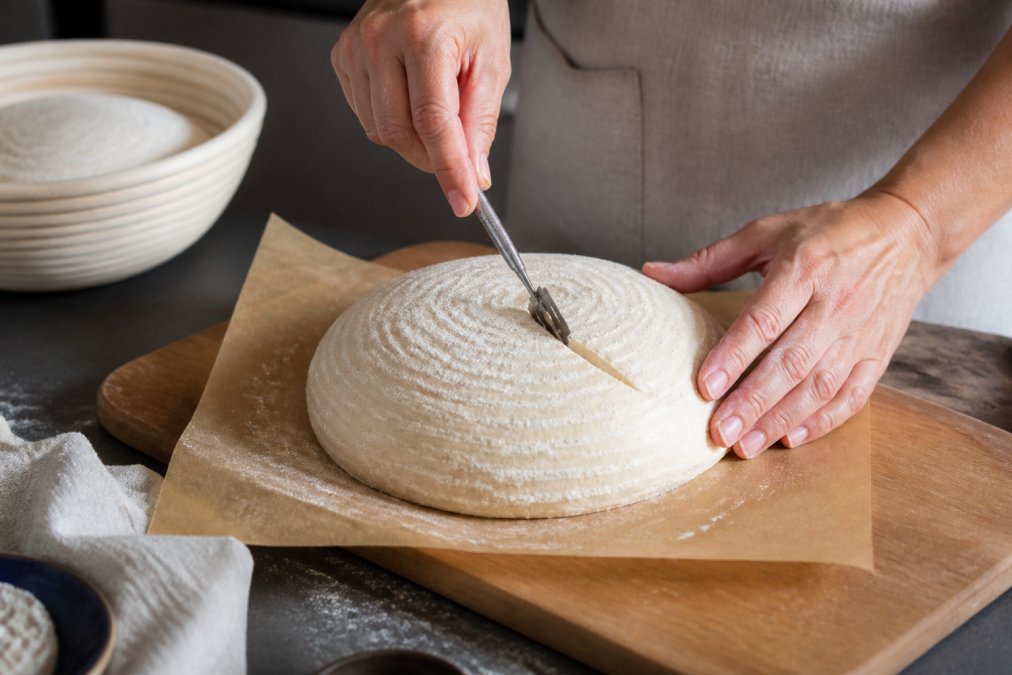
Start with your shaped dough on a lightly floured surface or banneton. The dough should be fully proofed but not overproofed, it should spring back slowly when you poke it, not collapse. Cold dough (straight from the fridge) is actually easier to score because it's firmer and less likely to tear.
Hold the lame at that 30-degree angle. The blade should be sharp enough that you don't need to force it. Press down and pull the blade toward you in one smooth motion. Depth matters: a typical expansion score is about a quarter-inch deep. Shallow decorative scores are half that depth.
White Magnetic Retractable Bread Lame →
For your first loaf, stick to a single expansion score down the center or a diagonal slash. One clean cut. Once you nail that, add decorative shallow scores on top. The expansion score does the work; the decorative scores are just for appearance.
Common beginner mistakes: holding the blade too vertical (that's 90 degrees, not 30), which requires too much force and tears the dough; hesitating mid-cut, which creates a ragged line instead of a clean slash; or using a dull blade, which drags through the dough instead of cutting it. All three are fixable. A sharp blade and the right angle solve most problems.
Deep vs. Shallow Scoring Sourdough: Technique and Purpose
Deep scoring and shallow scoring serve different jobs. Understanding the difference changes how you approach your loaf design.
A deep score, roughly a quarter-inch to three-eighths of an inch, controls oven spring. This is your expansion score. It tells the dough exactly where to open as it rises in the oven.
Sourdough Scoring Patterns: Creating Decorative and Functional Designs
Scoring patterns range from simple to intricate. Start simple and build complexity as you gain confidence.
Maintaining Dough Tension and Avoiding Common Scoring Mistakes
Dough tension is how tight your shaped loaf is. Proper tension means the dough holds its shape during scoring and oven spring. Loose tension means the dough spreads and your scores become distorted.
Replacing Razor Blades Safely and Maintaining Your Scoring Tool
Blades dull. A dull blade is your biggest enemy, it drags, tears, and makes you want to quit. Replacing blades is simple and takes 30 seconds.
USDA guidance on bread baking and fermentation
King Arthur Baking Company's sourdough scoring techniques
The Fresh Loaf community forum on dough scoring methods
Frequently Asked Questions
What is the best tool for scoring sourdough bread?
The best sourdough scoring tools depend on your comfort level and budget. Retractable magnetic lames offer safety and precision control, making them ideal for beginners who want to protect their hands when not scoring. Wooden handle lames provide a simple, traditional approach with an ergonomic grip. Both types use sharp razor blades and deliver clean expansion cuts and decorative patterns. Choose based on whether you prefer the retractable safety feature or a lighter, simpler design.
How do I choose between a retractable lame and a traditional wooden handle lame?
Retractable lames excel at safety and blade replacement, the magnetic holder makes swapping blades quick, and the sliding design keeps the blade covered during storage and handling. Wooden handle lames are lighter and simpler, with a natural wood aesthetic and ergonomic grip. Beginners often prefer retractable lames for the extra safety and included scoring guide. Experienced bakers may favor wooden handles for their minimal bulk. Both cost the same at $12.95, so the choice comes down to safety features versus simplicity.
What are common mistakes when scoring sourdough?
The most frequent errors include scoring too shallow or too deep, using a dull blade that drags instead of cutting cleanly, and not maintaining dough tension during the cut. Dragging causes ragged edges and uneven expansion. Scoring too shallow fails to guide oven spring, while too deep weakens dough structure. Beginners often hesitate, leading to tentative, uncontrolled strokes. The solution: use a sharp blade, score with one confident motion at a 30-degree angle, and keep your scoring tool's blade fresh by replacing it when it no longer cuts cleanly.
Do I really need a bread lame for sourdough, or can I use a serrated knife?
A dedicated bread lame delivers cleaner, more controlled cuts than a serrated knife. Serrated knives tend to drag and tear the dough surface, disrupting the skin and creating ragged edges that prevent proper oven spring and ear formation. A sharp razor blade in a lame cuts through the dough surface in one smooth motion, creating the clean score that guides expansion predictably. For artisan results and consistent oven spring, a lame is worth the $12.95 investment.
How often should I replace the razor blades in my sourdough scoring tool?
Replace your razor blade when it stops cutting cleanly and starts dragging through the dough. A sharp blade cuts with minimal resistance; a dull one tears and creates friction. Replace your razor blade when it stops cutting cleanly and starts dragging through the dough. A sharp blade cuts with minimal resistance; a dull one tears and creates friction. The My Rustic Roots retractable lame includes 5 replacement blades, and the magnetic holder makes swapping them simple. Keep spare blades on hand so you never score with a dull blade.