
What Size Proofing Cloth for a Sourdough Boule?
Last Updated: November 5, 2026
Quick Summary
Size your proofing cloth to the basket diameter plus twice the basket depth, plus a 10 cm overhang on each side to gather and secure. For example, a 25 cm basket that is 9 cm deep needs a 72 cm square proofing cloth, and a 35" x 30" cloth covers every basket size in our chart.
- Weigh dough after shaping, since final dough weight decides which basket diameter fits.
- Choose a basket about 2-3 cm wider than the shaped dough ball so it can expand.
- Dust the cloth with 1 to 2 tablespoons of rice flour for a 23-25 cm basket.
- Let excess fabric gather in loose pleats at the rim, keeping the center smooth.
- Skip fabric softener, which coats cotton fibers and makes dough cling.
Table of Contents
- Why Cloth Size Decides Whether Your Boule Releases Cleanly
- Sourdough Proofing Basket Size by Dough Weight
- Picking the Right Banneton Size for a Sourdough Boule
- The Cloth Measurement Chart: Sizing by Boule Diameter and Dough Weight
- How to Line a Banneton With a Proofing Cloth
- How to Prevent Sourdough From Sticking to a Proofing Cloth
- Set Up Your Boule for a Clean Release
- Frequently Asked Questions
Why Cloth Size Decides Whether Your Boule Releases Cleanly
A proofing cloth that's too small will bunch under the dough and trap it. One that's too large leaves folds that crease the crust.
This guide from My Rustic Roots covers exactly that: how to size a proofing cloth for a sourdough boule, by basket diameter and dough weight.
Most guides skip this. They tell you to "line the basket" and move on.
Basket Liner, Proofing Cloth, or Baker's Couche: What's the Difference
These three terms get used interchangeably. They shouldn't be.
- Basket liner: A fitted cloth sewn or sized to sit inside a banneton, often with an elastic edge.
- Proofing cloth: A flat piece of cotton or linen you drape, gather, and secure yourself. Our reusable 100% cotton proofing cloth is 35" x 30", which covers most round baskets with room to spare.
- Baker's couche: A large linen sheet used to proof shaped dough on a flat board, not in a basket. It's for batards and baguettes.
For a round boule, a proofing cloth is the most flexible option. It fits any basket size, and you control how tight it wraps.

Sourdough Proofing Basket Size by Dough Weight
Basket size should follow dough weight, not the other way around. A basket that's too big lets the dough spread sideways instead of rising upward, so the boule bakes flat. Too small, and the dough overflows the rim, sticks to the cloth, and tears on release.
Here's the working range most home bakers land on:
| Dough weight | Basket diameter | Basket depth | Typical loaf |
|---|---|---|---|
| 500-700 g | 20-22 cm | 8 cm | Small boule, 2-3 servings |
| 800-1,000 g | 23-25 cm | 8-9 cm | Medium boule, standard 900 g recipe |
| 1,100-1,500 g | 26-28 cm | 9-10 cm | Large boule, family loaf |
Weigh your dough after shaping, not before. Final dough weight includes flour, water, salt, and starter, and it's the number that matters for fit.
Why the Basket Needs Room to Expand
During the final proof, a shaped boule expands in two directions: upward as the gluten relaxes and the yeast produces gas, and outward against the basket wall. A round boule can grow noticeably in diameter during a cold retard, depending on hydration and starter strength. That expansion is why the basket should be about 2-3 cm wider than the shaped dough ball at the moment it goes in, the gap absorbs the outward push without letting the dough slump.
A dough that fills the basket rim-to-rim at the start of proofing has nowhere to go but over the edge. A dough that sits 2-3 cm inside the rim has room to rise and still release cleanly.
Matching Basket Size to a Recipe
If you're working from a recipe rather than a dough weight, convert first.
A few practical rules for common recipe sizes:
- Small boules under 700 g total dough: a 20-22 cm round basket
- Standard boules around 900-1,000 g: a 23-25 cm round basket
- Large family loaves over 1,100 g: a 26-28 cm round basket
Watch out: a basket that is the right diameter but too shallow (under 8 cm) will let a high-hydration dough climb the wall and stick to the cloth at the rim.
If you're still working on your shaping, our guide on how to shape sourdough boules for beginners walks through the tension-building step that makes a basket fit properly.
Picking the Right Banneton Size for a Sourdough Boule
Match the basket shape to the loaf you're building. A round basket makes a boule. An oval basket makes a batard.
For a boule, choose a round basket with a diameter roughly 2-3 cm wider than your shaped dough ball.
A few practical rules:
- Small boules under 700 g: a 20-22 cm round basket
- Standard boules around 900 g: a 23-25 cm round basket
- Large family loaves over 1,100 g: a 26-28 cm round basket
If you're still working on your shaping, our guide on how to shape sourdough boules for beginners walks through the tension-building step that makes a basket fit properly.
Bread Proofing Cloth - Reusable - 100% Cotton →
The Cloth Measurement Chart: Sizing by Boule Diameter and Dough Weight
Cloth size should equal basket diameter plus twice the basket depth, plus a 10 cm overhang on each side to gather and secure.
That's the formula. Here it is as a chart:
| Basket diameter | Basket depth | Minimum cloth size | Recommended cloth size |
|---|---|---|---|
| 20 cm | 8 cm | 56 cm square | 60 cm square |
| 23 cm | 8 cm | 62 cm square | 66 cm square |
| 25 cm | 9 cm | 68 cm square | 72 cm square |
| 28 cm | 10 cm | 76 cm square | 80 cm square |
A 35" x 30" cloth (about 89 x 76 cm) covers every basket in this table with room to fold.
If you're new to the whole process, sourdough bread making for absolute beginners explains where proofing fits before you buy anything.
How to Line a Banneton With a Proofing Cloth
Lining takes about two minutes. The goal is a smooth, taut surface with no folds pressed into the dough, and enough slack at the rim that the cloth can gather without pulling the boule's surface tight.
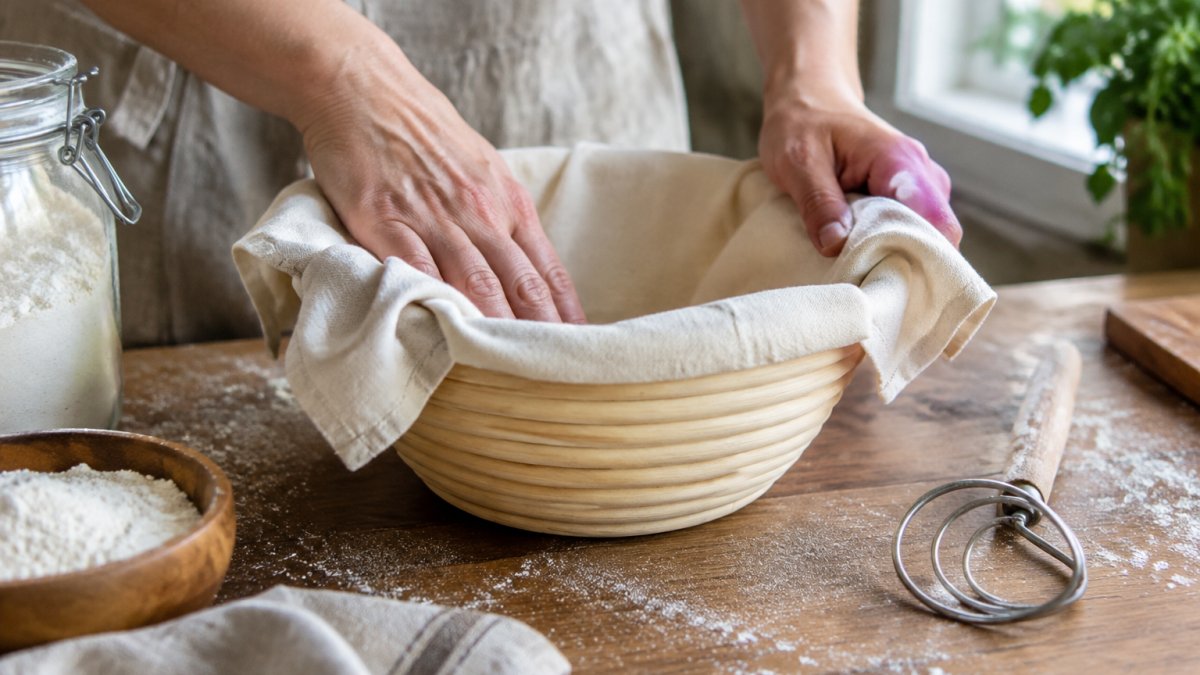
- Dust the cloth, not just the basket. Sprinkle rice flour or all-purpose flour across the center of the cloth in a circle roughly the diameter of the basket. Rice flour is often used for dusting because it has no gluten to grab the dough. A common pattern is 1 to 2 tablespoons for a 23-25 cm basket.
- Center the cloth with even overhang. Lay it over the basket so the overhang is equal on all sides. For a 25 cm basket with a 72 cm cloth, that's about 23 cm of overhang per side, enough to gather and tie without stretching.
- Press it in from the center out. Push the cloth down into the basket, smoothing wrinkles with your palm as you go outward. Work from the middle to the rim so trapped air and folds get pushed to the edge, not left in the center where the dough will press them into the crust.
- Handle the excess at the rim. This is where most liners go wrong. Don't tuck the cloth into the corners so tightly that it puckers the center. Instead, let the excess fabric gather in loose pleats at the rim, then fold those pleats outward over the basket edge. The center of the cloth should stay smooth and flat; the folds live outside the dough's footprint.
- Place the dough seam-side up and gather loosely. Set the shaped boule in the center, then bring the cloth corners up and over the top. Tie them or tuck them under themselves so the cloth stays put, but leave a finger's width of slack. The cloth should rest on the dough, not compress it.
Don't pull the cloth tight over the dough. It needs a little slack to rise. A cloth pulled taut across the top will leave a flat, compressed band on the crust where the fabric pressed down during the cold retard.
How to Fold, Gather, and Secure the Cloth
The fold method matters more than the cloth size once the cloth is large enough. Three habits keep the surface clean:
- Gather, don't wrap. Bring the corners together above the center and twist once, then tuck the twist under itself. Wrapping the cloth flat across the top and tucking the ends under the basket creates tension lines that press into the dough.
- Keep pleats outside the rim. Any fold that sits inside the basket wall will imprint on the boule. Push pleats to the outside edge before the dough goes in.
- Secure with the overhang, not a knot. A loose knot at the top is fine, but a tight knot pulls the cloth down onto the dough. Tucking the gathered corners under the basket's rim holds the cloth without compressing the loaf.
Lining Bowls, Trays, and Multiple Loaves
The same method scales to other proofing setups. For a mixing bowl, measure the bowl's diameter and depth the same way you would a basket, add the overhang, and choose a cloth that covers the rim by at least 10 cm per side.
Watch out: a cloth that is large enough but not centered will leave one side with too little overhang to gather, and the cloth will slip off the rim during the cold retard. Center first, then press.
How to Prevent Sourdough From Sticking to a Proofing Cloth
Sticking almost always comes down to three things: too little flour, too wet a dough, or a cloth that's been washed with detergent and lost its natural release.
Try these fixes in order:
- Flour more generously. Coat the cloth, not just the dough. Rice flour is the most reliable.
- Dry the dough surface. A slightly tacky surface grabs fabric. Let the shaped boule rest uncovered for a few minutes.
- Skip fabric softener. It coats cotton fibers and makes dough cling. Wash cloths plain and air dry.
Avoid scrubbing a proofing cloth with soap and hot water after every bake, as frequent washing can wear the fibers down. Rinse, air dry, and wash only when needed.
Set Up Your Boule for a Clean Release
A clean release is a setup problem, not a luck problem. Get the basket, cloth, and flour right, and the boule drops out on its own.
Before you bake, run this check:
- Cloth is sized to basket diameter plus depth plus overhang
- Cloth is dusted with rice flour or all-purpose flour
- Dough is seam-side up and centered
When you're ready to bake, invert the basket onto parchment or a bread sling so the dough lands without stretching. If you want the full toolkit that supports this step, our list of essential sourdough baking tools covers what pairs with a lined basket.
Frequently Asked Questions
Should a proofing cloth be larger than the banneton?
Yes. The cloth needs to cover the inside of the basket plus enough overhang to gather and secure at the rim. For a round basket, aim for a square at least 10 to 15 cm (4 to 6 inches) wider than the basket's diameter on each side. A 20 cm boule basket, for example, works well with a cloth around 50 cm (20 inches) square. A 35 x 30 inch cloth like the one from My Rustic Roots can be folded down to fit most home baskets.
How do I know what size banneton to get for my usual loaf?
Start with your final dough weight, not the basket's outside measurements. A 700 to 900 g dough fits a 20 cm (8 inch) round banneton; 900 to 1,200 g needs a 23 cm (9 inch) basket. If your dough regularly pushes above the rim before it is fully proofed, size up. A banneton size for sourdough boule should leave a little headroom so the shaped dough can expand without spilling over.
Can I use cheesecloth to proof sourdough bread?
Cheesecloth is too thin and open-weave for proofing. Dough pushes through the holes, and the cloth dries onto the surface, which makes release messy. A tightly woven cotton or linen proofing cloth holds a light dusting of flour and peels away cleanly. Save cheesecloth for straining and use a dedicated proofing cloth or basket liner instead.
How do I keep sourdough dough from sticking to a proofing cloth?
Dust the cloth with a 50/50 mix of all-purpose flour and rice flour before the shaped dough goes in, and don't skimp on the edges where the dough touches the fabric. Keep the cloth dry; a damp cloth glues itself to the dough. After cold proofing, let the basket sit at room temperature for 10 to 15 minutes, then lift the cloth gently from the edges before flipping. Wash and fully dry the cloth between bakes.
Sizing a proofing cloth is one of those small details that decides whether your bake goes smoothly or ends with dough stuck to fabric. At My Rustic Roots, we make a reusable 100% cotton proofing cloth sized to fit standard round baskets, plus the starters and tools that support the rest of the process. Get started with My Rustic Roots and line your banneton with a cloth that fits the first time.
